Top Jewelry POS Systems: How to Build a Shortlist
Search for the top jewelry POS systems and you will find a dozen ranked lists, most of them written by someone with an affiliate link. We build jewellery software, so our own top 10 would be worth exactly as little. What we can offer is the method — the questions that actually separate one jewelry POS software solution from another once the demos start blurring together.
Why feature grids do not help
Every vendor ticks every box. Inventory, CRM, reporting, multi-store, barcode — nobody selling point of sale software for jewelers admits to missing any of it. The grid tells you what exists, not whether it works the way this trade needs, and the gap between those two is where implementations fail.
So stop comparing capability lists and start comparing behaviour on your own data. Four tests do most of the sorting.
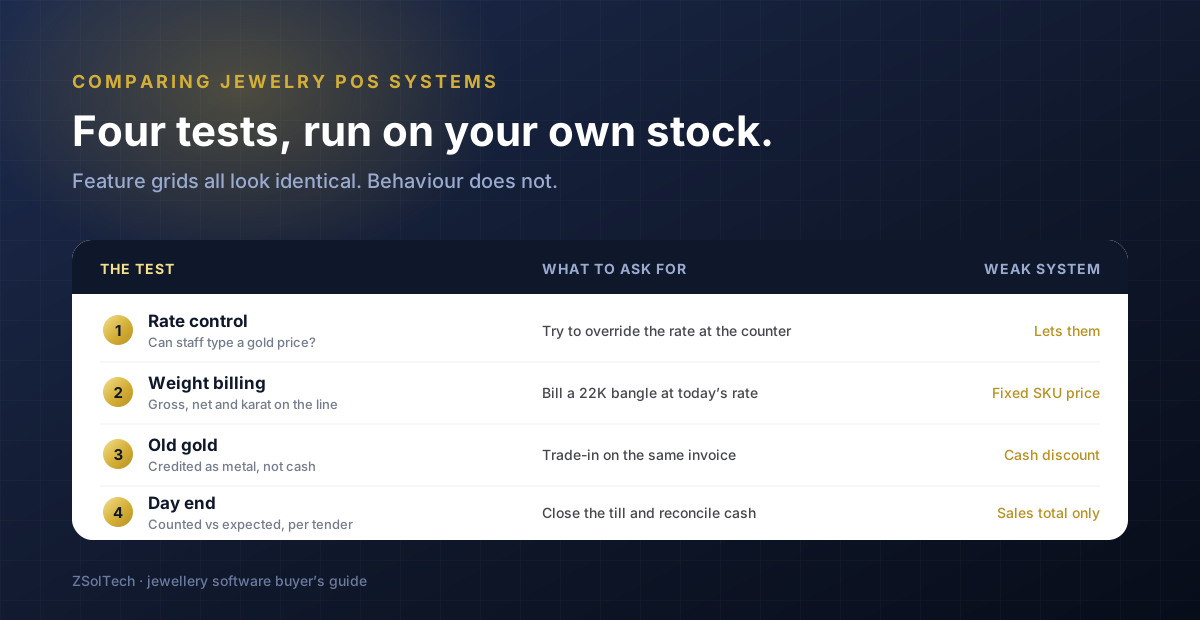
The four tests that separate jewelry POS systems
| Test | What to ask for | What a weak system does |
|---|---|---|
| Rate control | Show me a salesperson trying to type their own gold price | Lets them, or hides the rate in a settings screen only admin sees |
| Weight billing | Bill a 22K bangle by gross and net weight at today's rate | Prices by fixed SKU, with weight typed into a description field |
| Old gold | Take a trade-in against this sale on the same invoice | Records it as a cash discount, so your metal position drifts |
| Day end | Close the till against counted cash, per tender | Prints a sales total and calls it a closing report |
A system that handles all four in one flow belongs on your shortlist. One that needs a workaround for two of them will need that workaround every day for the next five years, and your staff — not the vendor — will be the ones performing it.
Two questions nobody asks until it is too late
What happens at branch three? Plenty of systems handle one shop beautifully and become a reconciliation exercise at three, because each location runs its own database. Ask to see consolidated stock across branches in a live demo, not a slide.
What does implementation actually cost? The monthly licence is the number vendors compete on, so it is the number they keep low. Get the implementation, migration and training figures in writing before you compare anything. In this category the one-off often exceeds the first year of subscription.
On iPads, tablets and cloud
Best jewelry store iPad POS software is a real search, and the honest answer is that a tablet is excellent for a manager on the floor and mediocre at the main counter. The counter needs a label printer, a scanner and — critically — a weighing scale, and those connect far more reliably to a desktop terminal. Use a tablet as a second screen, not as the till.
Cloud versus on-premise is a connectivity question, not a quality one. If your line is unreliable, a local database keeps the counter billing during an outage. If you run several branches, hosting gives head office one live view. Serious vendors offer both; be wary of anyone who insists there is only one right answer.
How to read a top 10 list
Ranked lists of jewellery software in India, the Gulf or the US are useful for one thing: assembling names. Take the names, discard the ranking, then run your own four tests. Check the review dates too — a system praised in 2019 may have changed hands twice since. And search each vendor's name alongside the word *migration*, because the people who left are more informative than the people who stayed.
Where we fit, stated plainly
ZSolTech is a jewellery-specific platform: POS, inventory by weight, manufacturing, wholesale and accounting on one database, with the gold rate locked to a daily karat master. We publish our pricing — $300, $499 and $999 per branch per month — because a shortlist you cannot cost is not a shortlist. We do not have a public REST API, and we say so on the integrations page rather than in a footnote.
Run the four tests on us as well. If we fail one for your business, you have learned something useful and it cost you an hour.
Frequently asked questions
What is the best jewelry POS system?
There is no single best jewelry point of sale system, and any vendor who names one is naming themselves. The system that fits is decided by four things: whether staff can override the gold rate, whether billing works from gross and net weight, whether old gold is credited as metal rather than as a discount, and whether the day closes against counted cash per tender. Run those four on your own stock during a demo. The shortlist usually reduces itself to two.
How should I compare jewelry POS software solutions?
On behaviour rather than feature grids, because every vendor ticks every box. Give each shortlisted system the same four transactions to perform live on your data — a weight-based sale, an old-gold exchange on the same invoice, a split payment, and a day-end close — then compare how many steps each took and how many workarounds appeared. Also get implementation, migration and training quoted in writing, since that one-off frequently exceeds the first year of licence.
What is the best software for a jewelry business overall?
It depends which of three businesses you are. A single showroom needs the counter, stock by weight and clean books. A workshop or wholesaler needs metal fixing, karigar accounts and memo before it needs loyalty tiers. A group needs one database across branches before anything else. Buying enterprise machinery for one counter wastes money; buying a single-shop tool before opening a second location means migrating twice. Judge on the three or four processes that actually break in your shop.
Are top 10 jewellery software lists reliable?
Treat them as a source of names, not a ranking. Most are affiliate-funded or ordered by marketing spend, and many carry reviews several years old for products that have since changed ownership or architecture. Take the names, check the review dates, search each vendor alongside the word migration to find the people who left, then run your own tests. A list is a starting point; it is not diligence.

Written by AaravJewelry Software Specialist
Aarav is a jewelry software specialist at ZSolTech with a decade in jewellery-trade systems — POS, weight-based inventory, karigar job-work and gold-rate pricing. The buyer's guides and how-tos on this blog draw on implementations for retailers, wholesalers and manufacturers across the US, Gulf and South Asia.
See it on your own data
The fastest way to judge any jewelry software is a demo against your real workflows.
Book a demoKeep reading
How to Inventory Jewelry: Numbering, Tracking & a Free Sheet
Tag numbering that cannot collide, the four weights every piece needs, and a stock sheet that reconciles. The method behind a count that balances.
Read ComparisonJewelCloud vs Jewelry ERP: Which Do You Need?
JewelCloud puts vendor catalogs on your website; a jewelry ERP runs the counter, vault and books behind it. How to tell which one you are missing.
Read