ERP for Jewelry Business: What to Look For
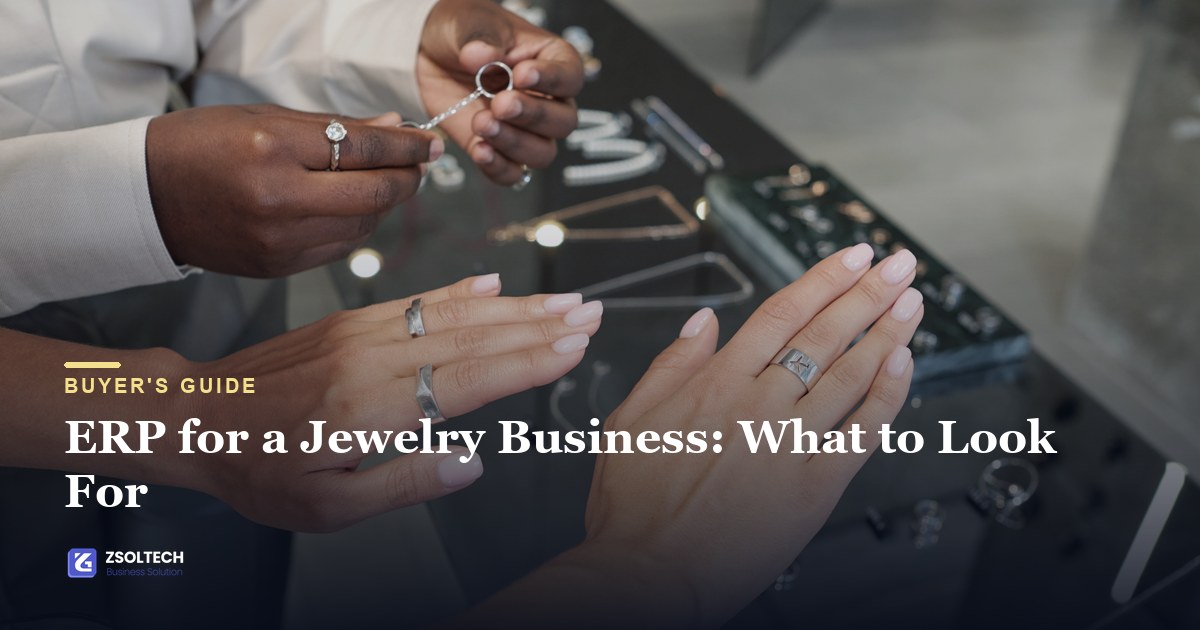
Choosing an ERP for a jewelry business is not the same as choosing one for a hardware store. Jewelry runs on weight, purity, making charges, live metal prices, recovery and trust — and most generic systems ignore every one of those. If you evaluate jewelry software the way you'd evaluate a generic ERP, you'll buy the wrong tool. This guide covers the ten capabilities that actually matter.
1. Dual tracking — by weight and by piece
A diamond ring is both a physical piece (one SKU, one barcode) and a quantity of metal and stones (grams, karat, carats). Good jewelry software tracks both axes at once, so a single item carries its weight, purity, certification and location. Generic ERPs only know "quantity × price" — which falls apart the moment gold rates move.
2. Live metal pricing and a karat master
Gold and silver prices move every day, sometimes every minute. Your system should price sales, buy-backs and inventory revaluation against live rates, with a daily karat master holding sale and purchase rates for 14K, 18K, 21K, 22K, 24K, 925 and more. Manual rate entry at the counter is where margin quietly leaks.
3. Diamond and gemstone handling (the 4Cs)
If you sell diamonds, your software must capture the 4Cs — Cut, Colour, Clarity and Carat — plus shape and lab certificate (GIA, IGI, HRD). Those details should flow onto the invoice, the image catalogue and the audit trail. Loose-stone, pearl and colour-stone masters matter too.
4. Manufacturing and repairs
Retail-only systems treat the workshop as a black box. Real jewelry ERP tracks issue-to-recovery: metal issued to casting/setting/polishing, metal recovered, wastage and artisan labour costing. A proper repair desk — receipt, issue to workshop, receive, customer delivery — is just as important.
- Metal & diamond manufacturing with recovery and wastage
- Boiling / refining process tracking
- Hallmarking and gold-bar certification
- Full repair workflow with a repair register
5. Old-gold exchange and buy-back
Old-gold exchange is a daily reality in most showrooms. The system should value old gold at a live buy-back rate, net it against the new sale, and post it correctly — not force staff to do mental arithmetic.
6. Multi-branch and consolidation
If you run more than one location, you need controlled inter-branch transfers, in-transit documents and a consolidated head-office view. Month-end shouldn't mean a week of stitching spreadsheets together.
7. Compliance built in
Jewelry sits under real regulatory scrutiny. Look for native VAT/GST, AML monitoring, KYC with a document vault, tourist VAT refund, and immutable audit trails — not a tax plug-in bolted on afterwards.
8. Loyalty, schemes and CRM
Repeat customers are the lifeblood of the trade. Strong software includes tiered loyalty, gift vouchers, gold-savings schemes (chits/plans) and a CRM rich enough to capture preferences and occasions — and ideally suggest the next purchase from buying patterns.
9. Deployment that fits your policy
Some businesses want fully managed cloud; others require on-premise SQL Server for control, or a hybrid. The vendor should support whichever your security policy demands, with multi-currency and multi-language (e.g. English and Arabic).
10. Migration and support
The best software fails without a smooth rollout. Confirm the vendor migrates your stock, ledgers, customers and rate history, trains your team by role, and offers responsive, multilingual support with clear SLAs.
A quick checklist
- Tracks by weight and by piece/barcode
- Live gold/metal pricing + daily karat master
- 4C diamond grading + certificates
- Manufacturing, recovery, wastage and repairs
- Old-gold exchange & buy-back
- Multi-branch transfers & consolidation
- Native VAT/GST, AML, KYC & audit trail
- Loyalty, schemes, gift vouchers & CRM
- Cloud or on-premise deployment
- Data migration, training & real support
“If a vendor can't talk fluently about karat rates, making charges, recovery and the 4Cs in the first call, they didn't build software for jewelers.
ZSolTech was built around exactly these requirements — it's jewelry software, not a generic ERP with a jewelry skin. Budgeting the project? See our transparent jewelry ERP pricing — plans from $300/month. If you're evaluating options, a tailored demo against your real workflows is the fastest way to see the difference.
Related reading: How to Choose Jewelry Software: A Buyer's Guide — the vendor-comparison questions and red flags that pair with this capability checklist.
Frequently asked questions
What is an ERP for a jewelry business?
A jewelry ERP runs the whole business in one system: POS with live gold-rate pricing and old-gold exchange, inventory by weight (grams/karat) and piece (barcode/RFID), manufacturing job cards with wastage and recovery, double-entry accounting for both money and metal, and VAT/GST-AML compliance. The metal-aware data model is what separates it from generic ERPs.
What should I look for when choosing a jewelry ERP?
Six non-negotiables: live karat-wise gold pricing, dual weight-and-piece inventory, old-gold exchange inside the sale flow, issue-to-recovery manufacturing job cards, native metal + money accounting, and built-in tax/AML compliance for your market. Ask every vendor to demo these on your data — not slides.
How much does a jewelry ERP cost?
Pricing across the industry is often hidden behind sales calls. ZSolTech publishes its plans — $300/month (retail), $499/month (professional/manufacturing) and $999/month (enterprise) per branch, with annual billing discounts. Use published pricing as a baseline when vendors quote you privately.
How long does jewelry ERP implementation take?
For most retailers, 2–6 weeks with a competent vendor: data migration of item masters, customers, balances and stock, role-based training, then a guided go-live. Multi-branch and manufacturing rollouts run longer. Be wary of vendors who can't commit to a timeline.

Written by AaravJewelry Software Specialist
Aarav is a jewelry software specialist at ZSolTech with a decade in jewellery-trade systems — POS, weight-based inventory, karigar job-work and gold-rate pricing. The buyer's guides and how-tos on this blog draw on implementations for retailers, wholesalers and manufacturers across the US, Gulf and South Asia.
See it on your own data
The fastest way to judge any jewelry software is a demo against your real workflows.
Book a demoKeep reading
Top Jewelry POS Systems: How to Build a Shortlist
We are a vendor, so we will not rank ourselves first. Here is the method buyers use to shortlist a jewelry POS system — and the four tests that separate them.
Read GuideHow to Inventory Jewelry: Numbering, Tracking & a Free Sheet
Tag numbering that cannot collide, the four weights every piece needs, and a stock sheet that reconciles. The method behind a count that balances.
Read